






Company
Our Mission.
Security model
Passive observability. Distributed architecture. Autonomous communications. Deterministic detection.
Founded
Netherlands, 2015
Focus
Critical IT, OT, defence, public infrastructure and industrial environments.
Principle
Security systems should not increase the operational risk of the systems they protect.
P-X Systems was founded in the Netherlands in 2015 by security professionals with experience in high-security and operationally sensitive environments.
From the beginning, our focus was not conventional IT security, but the harder challenge of protecting critical systems where continuity, control and trust are non-negotiable.
As digital infrastructure became increasingly connected, cybersecurity evolved around assumptions of permanent connectivity, software abstraction and centralised dependency. In many environments, that model is acceptable. In critical environments, it can become a risk in itself.
Some systems cannot tolerate instability introduced by the very security measures meant to protect them. In critical environments, instability can mean embedded security software causing malfunction, additional network or system load, interrupted connectivity, or probabilistic AI analysis generating false positives and incorrect intervention.
The consequences of disruption are also fundamentally different in critical environments. A conventional IT outage may result in temporary loss of productivity or revenue. In critical infrastructure or high-security environments, disruption can have operational, physical or strategic consequences that persist long after systems come back online.
Industrial processes may require days or weeks to stabilise after emergency shutdowns. Biological or chemical treatment systems can lose delicate equilibrium states that are difficult to restore. In tightly interconnected supply chains, even short disruptions can trigger cascading operational and economic effects far beyond the original incident. In defence and high-security environments, disruption itself can become a strategic event. The loss of sensitive information represents another form of irreversible impact: once exposed, it can never truly be undone.
These environments require a fundamentally different security model.
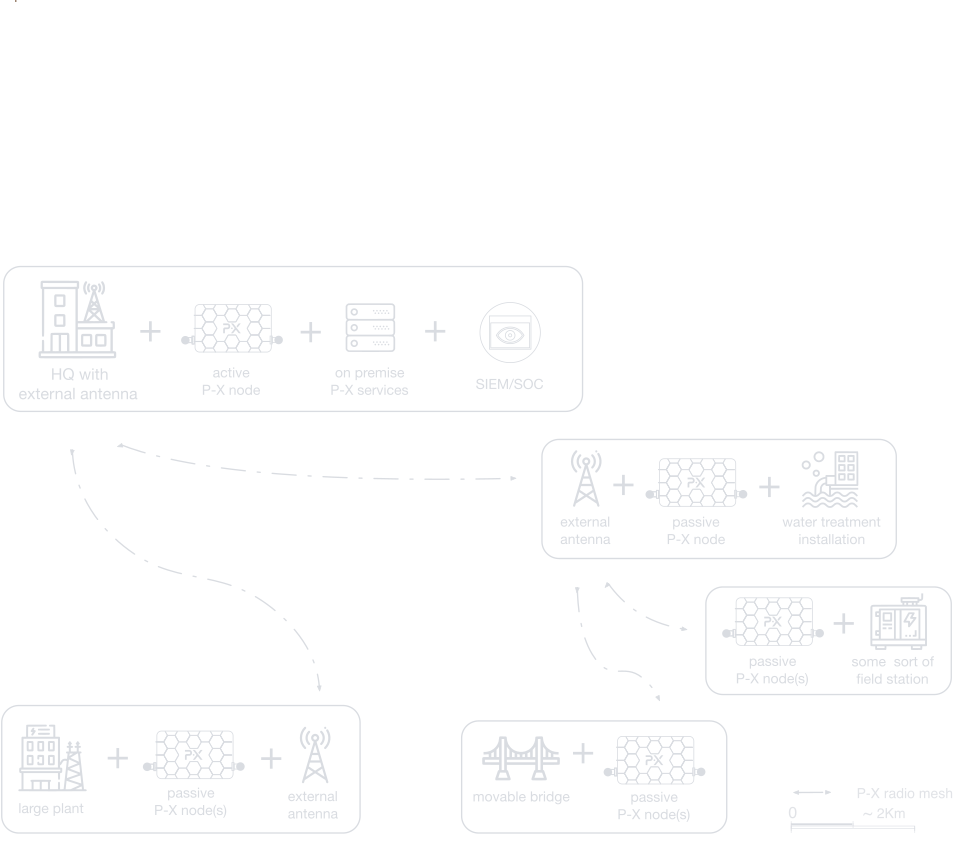
P-X develops technology built around distributed observability: passive and non-intrusive monitoring combined with autonomous communication infrastructure and deterministic detection strategies engineered around the operational realities of critical environments rather than the assumptions on which most cybersecurity architectures are built.
Many of the underlying design principles are commonplace within defence, intelligence and national-security environments, where resilience, autonomy and graceful degradation are considered fundamental requirements rather than optional features. P-X applies these same principles to critical infrastructure, industrial operations and other essential environments that increasingly face similar operational realities.
For that reason, P-X is engineered to operate independently from the infrastructure it monitors, maintaining visibility during outages, attacks and crisis situations without increasing operational risk or dependency. Rather than replacing existing security investments, P-X complements and strengthens them by extending visibility, detection and operational awareness beyond the assumptions of trusted infrastructure and uninterrupted communications on which most cybersecurity architectures depend.
Critical environments are often highly deterministic by nature. This allows abnormal behaviour to be identified with extreme precision using deterministic detection strategies inspired in part by biological immune systems, without depending on intrusive software, permanent cloud connectivity or low-confidence probabilistic analysis.
P-X therefore prioritises trustworthy and operationally relevant intelligence. Deterministic detection strategies provide a strong foundation, while machine learning, anomaly detection and other forms of artificial intelligence are employed where they provide measurable operational value without compromising the quality and trustworthiness of the resulting intelligence.
The resulting architecture reflects the operational realities of critical environments rather than the boundaries traditionally drawn between monitoring, communications and protection.
In these environments, guessed information can be more dangerous than no information at all.
Today, P-X Systems remains a 100% Dutch deep-tech cybersecurity company developing its own technology stack, including proprietary hardware, embedded systems and autonomous communication infrastructure.
As cyber resilience becomes increasingly linked to sovereignty, continuity and supply chain assurance, our mission remains unchanged: making defence-grade security principles applicable to the critical systems modern society depends on every day.